Note
Go to the end to download the full example code.
Skops model cards with a custom template
By default, when using skops.card.Card, the skops model card template
is being used, which adds a couple of useful sections and a general document
structure to the model card. In some cases, it might, however, be desired to
use a different template because the skops template doesn’t fit our needs. This
document shows how to use a custom template.
Imports
from tempfile import mkstemp

from sklearn.datasets import fetch_california_housing
from sklearn.ensemble import RandomForestRegressor
from sklearn.inspection import PartialDependenceDisplay
from sklearn.metrics import mean_absolute_error, mean_squared_error, r2_score
from sklearn.model_selection import train_test_split

from skops import card
from skops import io as sio
Loading California Housing dataset
X, y = fetch_california_housing(return_X_y=True, as_frame=True)
X_train, X_test, y_train, y_test = train_test_split(X, y, random_state=0)
Training the RandomForestRegressor
est = RandomForestRegressor(n_estimators=10, random_state=0)
est.fit(X_train, y_train)
Save the model
_, model_file_name = mkstemp(prefix="skops-", suffix=".skops")
sio.dump(est, model_file_name)
Create the model card
Initialize the empty card and add a few sections
Instead of using the default skops template, let’s define our own custom
template to use in this example. A template is a simple dictionary whose keys
are the section names and whose values are the contents of the sections. Both
keys and values should be strings, and values may be empty strings if you want
to only add a section without any content (yet). As always, subsections are
delimited using a "/".
Once such a template is defined, it can be passed to the
skops.card.Card class using the template argument. You may also
pass template=None to start with a completely empty model card.
link = (
    "https://scikit-learn.org/stable"
    "/auto_examples/release_highlights/plot_release_highlights_0_24_0.html"
    "#individual-conditional-expectation-plots"
)
dataset_name = "California Housing"
custom_template = {
    "Regression on California Housing dataset": (
        f"This example is adopted from [here]({link})."
    ),
    f"Regression on {dataset_name} dataset/Model Description": (
        f"Use the `{est.__class__.__name__}` from sklearn."
    ),
    f"Regression on {dataset_name} dataset/Usage": "This is only for demo purposes.",
    f"Regression on {dataset_name} dataset/Results": "",
}
model_card = card.Card(est, template=custom_template)
Adding more content to the model card
From here on out, feel free to edit the model card as you would always do by
calling the different methods starting with add, such as
skops.card.Card.add(). and skops.card.Card.add_metrics(). Below,
we add more content to the model card to demonstrate this.
Add metrics
y_pred = est.predict(X_test)
metrics_dict = {
    "R-squared": r2_score(y_test, y_pred),
    "Mean absolute error": mean_absolute_error(y_test, y_pred),
    "Mean squared error": mean_squared_error(y_test, y_pred),
}
model_card.add_metrics(
    section="Regression on California Housing dataset/Results/Metrics",
    description=(
        "Metrics are determined on a random split consisting of 25% of the data"
    ),
    **metrics_dict,
)
Card(
  model=RandomForestRegressor(n_estimators=10, random_state=0),
  Regression on California Housing dataset=This example is a...pectation-plots).,
  Regression on California Housing dataset/Model Description=Use the ...sklearn.,
  Regression on California Housing dataset/Usage=This is only for demo purposes.,
  Regression on California Housing dataset/Results/Metrics=TableSection(3x2),
)
Add hyperparameter table
model_card.add_hyperparams(
    section=(
        "Regression on California Housing dataset/Model Description/Hyperparameters"
    ),
    description="The model was trained with the hyperparameters listed below",
)
Card(
  model=RandomForestRegressor(n_estimators=10, random_state=0),
  Regression on California Housing dataset=This example is a...pectation-plots).,
  Regression on California Housing dataset/Model Description=Use the ...sklearn.,
  Regression on California Housing dataset/Model Description/Hyperparameters=...,
  Regression on California Housing dataset/Usage=This is only for demo purposes.,
  Regression on California Housing dataset/Results/Metrics=TableSection(3x2),
)
Add the model diagram
model_card.add_model_plot(
    section="Regression on California Housing dataset/Model Description/Model Diagram",
)
Card(
  model=RandomForestRegressor(n_estimators=10, random_state=0),
  Regression on California Housing dataset=This example is a...pectation-plots).,
  Regression on California Housing dataset/Model Description=Use the ...sklearn.,
  Regression on California Housing dataset/Model Description/Hyperparameters=...,
  Regression on California Housing dataset/Model Description/Model Diagram=<...>,
  Regression on California Housing dataset/Usage=This is only for demo purposes.,
  Regression on California Housing dataset/Results/Metrics=TableSection(3x2),
)
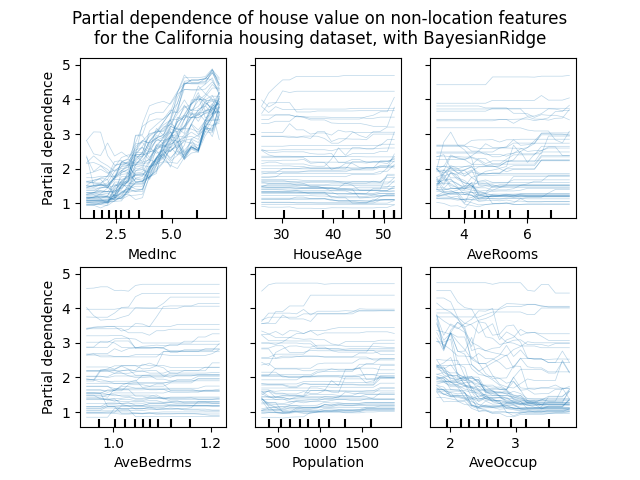
Add partial dependence plot
features = ["MedInc", "HouseAge", "AveRooms", "AveBedrms", "Population", "AveOccup"]
n_samples = 500  # make plot a bit faster
display = PartialDependenceDisplay.from_estimator(
    est,
    X[:n_samples],
    features,
    kind="individual",
    subsample=50,
    grid_resolution=20,
    random_state=0,
)
display.figure_.suptitle(
    "Partial dependence of house value on non-location features\n"
    "for the California housing dataset, with BayesianRidge"
)
display.figure_.subplots_adjust(hspace=0.3)
_, plot_file_name = mkstemp(prefix="skops-", suffix=".png")
display.figure_.savefig(plot_file_name)
model_card.add_plot(
    **{
        "Regression on California Housing dataset/Results/Partial Dependence Plots": (
            plot_file_name
        )
    },
)
Card(
  model=RandomForestRegressor(n_estimators=10, random_state=0),
  Regression on California Housing dataset=This example is a...pectation-plots).,
  Regression on California Housing dataset/Model Description=Use the ...sklearn.,
  Regression on California Housing dataset/Model Description/Hyperparameters=...,
  Regression on California Housing dataset/Model Description/Model Diagram=<...>,
  Regression on California Housing dataset/Usage=This is only for demo purposes.,
  Regression on California Housing dataset/Results/Metrics=TableSection(3x2),
  Regression on California Housing dataset/Results/Partial Dependence Plots=...),
)
Save the finished model card
_, card_file_name = mkstemp(prefix="skops-", suffix=".md")
model_card.save(card_file_name)
Further information
The model card created in this example is very bare bones, missing a lot of important information. It should only be used as a starting point and not be considered a complete example. If you would like to know more about model cards, the model card documentation on the Hugging Face Hub could be a good starting point.
Furthermore, this model card lacks metadata, which can be very useful if you
plan to upload the model on Hugging Face Hub. If you want to add metadata,
instantiate it using huggingface_hub.ModelCardData and pass it to the
skops.card.Card class.
Total running time of the script: (0 minutes 2.690 seconds)